Jesus on Cross Redwork Design: A Pro Review
As a designer who spends more time staring at stitch maps than most people spend looking at actual art, I approach every new machine embroidery design with a mix of excitement and skepticism. We've all been burned by files that look stunning in the preview but turn into a bird's nest of thread breaks and puckering on the actual fabric. So, when I pulled up the Jesus on Cross Redwork Design, my first instinct wasn't to imagine it on a mockup, but to analyze its structural integrity for real-world application.
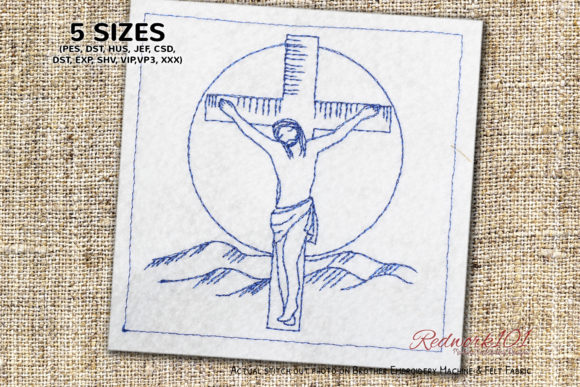
The immediate impression this design gives is one of solemn simplicity. Redwork has a specific visual language; it relies on the clarity of a single color—traditionally red, though modern interpretations vary—to create depth through line weight and spacing rather than dense fills. This particular file captures that aesthetic beautifully. The layout feels balanced, avoiding the clutter that often plagues religious imagery when scaled down for smaller hoops. It possesses a quiet dignity that makes it versatile, fitting seamlessly into both sacred contexts and rustic, farmhouse-style decor.
Real-World Application: The Tote Bag Test
To truly evaluate an embroidery file, you have to move beyond the screen. I decided to test this design on a project that demands durability and visual impact: a heavy canvas tote bag intended for a church gift shop. This is a common scenario for many Etsy sellers and craft business owners who need products that withstand daily use while maintaining a professional appearance.
Working with canvas presents challenges. The texture is coarse, and if your stitch density is too high, the needle can struggle to penetrate, leading to skipped stitches or fabric distortion. The Jesus on Cross Redwork Design performed exceptionally well here. Because it utilizes primarily running stitches and avoids heavy saturation, it sat on top of the canvas texture rather than fighting against it. The lines remained crisp, and the silhouette of the cross was immediately recognizable even from a distance.
I also considered how this would translate to custom apparel. Imagine stitching this onto a heather grey sweatshirt for a personalized gift. The open nature of redwork allows the fabric color to show through, creating a soft, integrated look that feels less like a sticker and more like part of the garment. For holiday embroidery projects, specifically within the Christmas season where red is a dominant theme, this design offers a spiritual anchor that complements traditional festive motifs without overwhelming them.
Navigating Fabric Challenges and Hoop Constraints
While the design shines on stable fabrics like cotton, linen, and canvas, caution is required when moving to trickier materials. If you are planning to use this on stretchy knits for baby embroidery or fitted caps, your preparation game needs to be strong. Redwork designs rely on continuous lines; if the fabric shifts even slightly during stitching, those lines can warp, distorting the sacred image.
For curved surfaces like caps, ensure you are using a cap frame and a sturdy cut-away stabilizer. The lack of dense fill stitches means there is less inherent stability in the design itself, so the stabilizer must do the heavy lifting. Similarly, on dark fabrics, the traditional red thread might not pop as effectively as it does on light backgrounds. In these cases, I recommend testing different thread colors. A gold or silver metallic thread could elevate the design for a boutique product, while a stark white might offer better contrast for nightwear or dark jackets.
Another critical factor is the hoop size. Always check the specific dimensions of the file you download. While redwork is generally scalable, shrinking this design too much could cause the finer details of the cross or the figure to merge together, losing definition. Conversely, enlarging it too much might make the running stitches look gappy. It is always best to stitch a test sample on scrap fabric of the same weight before committing to your final finished product.
Commercial Viability and Brand Consistency
For small shop product creators and digital embroidery file sellers, the commercial potential of this design lies in its adaptability. It fits perfectly into niches ranging from faith-based apparel to memorial gifts. However, professionalism is key. A sloppy stitch-out can damage your brand reputation faster than anything else.
The Jesus on Cross Redwork Design supports high perceived value because of its clean execution. When customers see precise, unbroken lines and a thoughtful composition, they associate that quality with your brand. Whether you are selling embroidered patches, kitchen towels, or pillow covers, this design adds a layer of authenticity. It doesn't scream "mass-produced"; instead, it feels like a handmade product crafted with care.
One specific note regarding the product description: the mention of an optional box stitch is crucial. In many designs, outer borders are separate color stops. If you are doing a monochromatic redwork piece, you will want to skip that color stop in your machine settings to maintain the single-color aesthetic. Failing to notice this could result in an unintended two-tone border that disrupts the visual flow. Always review the stitch sequence in your software before loading the file onto your machine.
Final Thoughts for the Practical Designer
In the world of commercial embroidery, reliability is everything. We need assets that work consistently across different machines and materials. The Jesus on Cross Redwork Design stands out as a reliable choice for designers who value clarity and tradition. It respects the medium of embroidery by utilizing the strengths of line work rather than forcing complex shading where it isn't needed.
Before adding this to your inventory or using it for a client order, remember to verify the licensing terms. Some designers allow unlimited commercial use for finished physical goods but restrict the resale of the digital file itself. Additionally, since specific stitch counts and exact hoop compatibility weren't detailed in the initial overview, downloading a preview or checking the vendor's detailed specs is a necessary step.
Ultimately, this design is a testament to the power of simplicity. It proves that you don't need thousands of stitches or a rainbow of thread colors to create something moving and beautiful. For the creative entrepreneur looking to expand their catalog with meaningful, high-quality items, this redwork design is a solid investment that bridges the gap between artistic expression and practical manufacturing.